Showing posts with label packet sniffer howto. Show all posts

Monday, April 27, 2009

How to Monitor Internet Traffic with Packet Sniffer

Internet traffic is the flow of data around the Internet. It includes web traffic, which is the amount of that data that is related to the World Wide Web, along with the traffic from other major uses of the Internet, such as electronic mail and peer-to-peer networks.


In case we want to monitor internet traffic generated or is generating in LAN, here is a detailed process how we can do it with Colasoft Packet Sniffer – Capsa.


Again we must make sure the packet sniffer software is correctly implemented so we can capture all the traffic in LAN, if you don’t know how to do it, please make sure you read how to implement a packet sniffer.


First let’s launch a new project with Colasoft Packet Sniffer, then do some online activities, such as chatting, browsing a website, sending and receiving emails, downloading some files. All these activities will generate different kinds of internet traffic. We may keep the project running to continuously monitor internet traffic or stop the project to do some analysis.


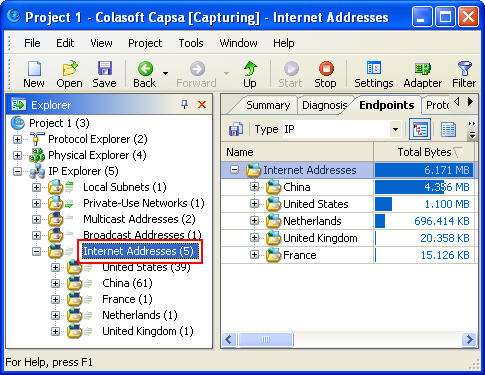
To monitor internet traffic, we’d better first select the “Internet Addresses” in the “Explorer” on the left window:

Monitor Internet Traffic Screenshot1


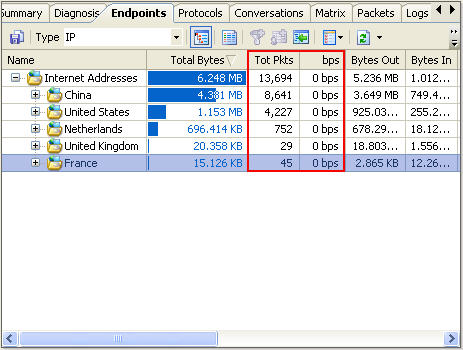
We can see that all the internet addresses are listed by countries, to monitor internet traffic of a specific country, we just need click on it; If we want to monitor internet traffic of a specific IP address within one country, we need to expand the country node and select the IP address in it.


Also we can monitor internet traffic aggregated or internet traffic in real-time

Monitor Internet Traffic Screenshot2


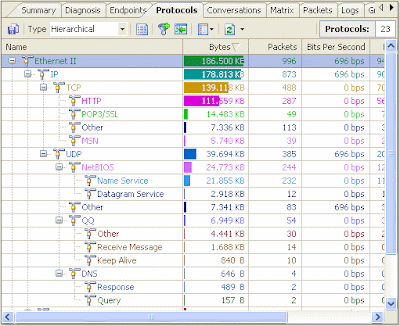
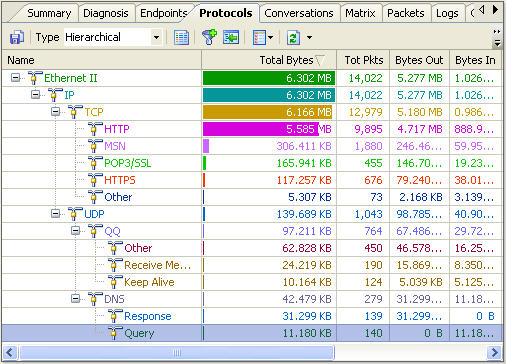
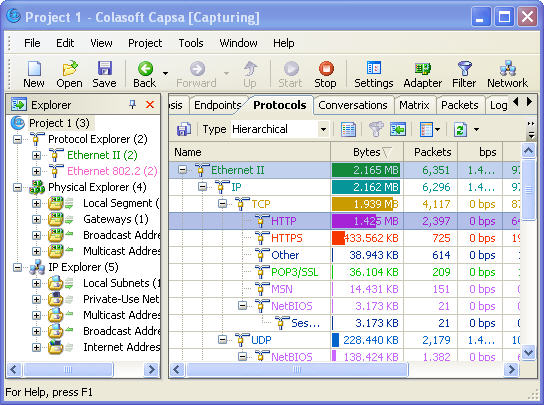
To view what online activities have generated or are generating internet traffic, we need to use the “Protocols” Tab.

Monitor Internet Traffic Screenshot1


We can see there are protocols which separately stand for different internet activities:


HTTP – Website browsing

MSN – online chatting with Live Messenger

POP3 – Email

HTTPS - Website browsing via a secure link

QQ- online chatting with QQ

DNS – Domain Name System


About Capsa


Colasoft Capsa is a network analyzer (packet sniffer or protocol analyzer) designed for network monitoring and troubleshooting. It performs packet capturing, network monitoring, protocol analyzing, packet decoding, and automatic diagnosing. By giving users insights into all of network's operations, Capsa makes it easy to isolate and solve network problems, identify network bottleneck and bandwidth use, and detect network vulnerabilities. Learn more about Capsa, please visit http://www.colasoft.com/capsa/


Thursday, April 23, 2009

How to Monitor http Traffic with Packet Sniffer

Hypertext Transfer Protocol (HTTP) is an application-level protocol for distributed, collaborative, hypermedia information systems. Its use for retrieving inter-linked resources led to the establishment of the World Wide Web.


In order to monitor http traffic, we will need a packet sniffer (or a protocol analyzer) software. Here is a detail process how we can monitor http traffic in LAN with Colasoft Packet Sniffer – Capsa.


Again let’s launch Colasoft Packet Sniffer and start a new project. Don’t forget one thing, we have to deploy the packet sniffer to the mirror port of the core switch in order to monitor all http traffic in LAN, if not, we can only monitor http traffic of our own computer.


Then let’s start browsing a website, for example, www.colasoft.com, to generate some http traffic. Now let’s get back to the packet sniffer and see if there is http traffic. OK, we can see the packet sniffer has already captured some http traffic in the “Protocols” Tab


Monitor http Traffic Screenshot 1


We can see both the aggregated http traffic since start capturing and the real-time http traffic in this tab.


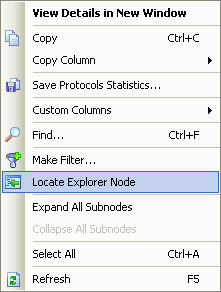
If we want to do a deeper analysis on http traffic, we will need to use the “Locate” function to locate http protocol in the Explorer to let the packet sniffer display only the data that is http protocol. Right click on the protocol and select “Locate Explorer Node” in the pop-up menu.


Locate Explorer Node


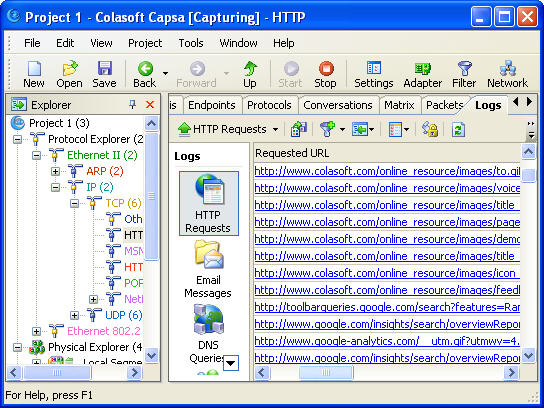
If we want to know who are using http protocol and what they are actually browsing, we are going to use two tabs, the “Endpoints” Tab and “Logs” Tab.


Let’s see who are using http protocol:


Who is Using http Protocol


And what they are actually browsing:


Monitor http Traffic Screenshot 4


Thursday, April 16, 2009

How to Protect Your Network with Packet Sniffer

A packet sniffer (also called a network analyzer) can help you make your network more secure by identifying what's going on in it

Networks are large entities, even if they don't consist of thousands of machines. Large networks are especially vulnerable because they are a fruitful ground for attacks and hacking of all kinds. Even if a system administrator is a genius, he or she can't fight network security threats with bare hands.

Why Do You Need to Protect Your Network?

One of the major principles in network security is that a network is as secure as its weakest part is. In other words, it makes no sense to invest tons of money and spend many hours to secure some of the parts of a network, when there are small vulnerabilities that can be easily abused.

With networks small vulnerabilities are very common and even though one can never be sure that his or her network is secure, when no efforts in that direction are made, it is as sure as hell that this network is at risk. That is why it is absolutely clear that nobody can afford to leave a network unprotected. Fortunately, there are many tools, which help to protect a network and packet sniffers are one of them.

How a Packet Sniffer Can Protect Your Network?

Packet sniffers (or network analyzers, as they are also called) can be one of the best tools you can use to protect your network. There are many types of network threats and there is no universal tool that can help you protect your network against all of them, so if you expect that a packet sniffer can safeguard your network against all kinds of threats, this is not so but it is a fact that a packet sniffer can help you against many threats, both internal and external.

colasoft packet sniffer

A packet sniffer captures all the packets which go to and from your network and shows you their contents. While a packet sniffer is helpless against encrypted traffic, with unencrypted traffic a packet sniffer is an indispensable tool. When you have the chance to know what's going on in your network, you can easily spot the activities, which shouldn't be taking place.

colasoft packet sniffer

For instance, if somebody is downloading files with BitTorrent, or is generating any other kind of substantial traffic, a packet sniffer, such as Colasoft Packet Sniffer, will display this immediately and you will know that you should take the adequate measures to stop it. Actually, a packet sniffer allows to monitor all incoming and outgoing traffic and keep logs of this, so even if you don't react immediately when suspicious traffic occurs, all the traffic is logged and you can view it later.

Depending on the features of the packet sniffer you have selected, you will have different options to protect your network. Some of the packet sniffers with a rich feature set, for instance Colasoft Packet sniffer, offers a lot in terms of traffic monitoring. Generally, even the packet sniffers with less features allow to monitor suspicious activity at least from a given host or protocol.

One of the cases when packet sniffers don't offer much help is with encrypted traffic. This is a technical limitation and even though packet sniffers can intercept encrypted packets, they can't break the encryption and show the actual content of the packet. However, when you are monitoring a network and you notice that there is unauthorized encrypted traffic (for instance from a given host), this should ring a bell that something not nice is probably going on and you should take the adequate measures to investigate what exactly is happening.


Tuesday, April 14, 2009

How to Sniff All Images of a Webpage

In case we want to sniff all images of a webpage, here is a detailed process how we can do it with Colasoft Packet Sniffer’s "Logs" feature. I will take the CNN.com home page as an example.

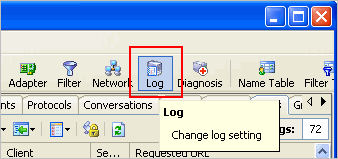
Step 1. Open Log Settings

Log settings allows us to set up some conditions or exceptions whether or not record some logs in the Logs tab. If we want to display just images in the Logs tab, we must enable the HTTP Log conditions.

How to Sniff Images Screenshot 1

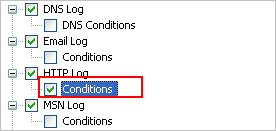
Step 2. Enable Http Log Conditions

We must tick before Conditions to enable it

How to Sniff Images Screenshot 2

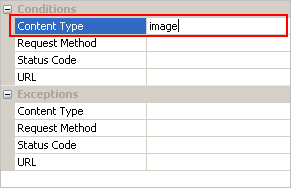
Step 3. Input "Image" into Content Type

On the right hand, lets’ input the content type in order to filter contents

How to Sniffer Images Screenshot 3

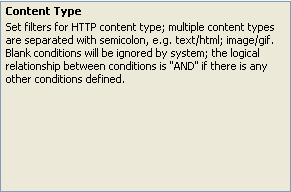
Here is an explanation of Content Type

How to Sniff Images Screeshot 4

Step 4. "OK" to Activate the Setting

Now we’ve done with the Log Settings, let’s see whether we can sniff all images of CNN.com index page. First of all, let’s start capturing with Colasoft Packet Sniffer, then let’s input the URL into the address bar and start browsing.

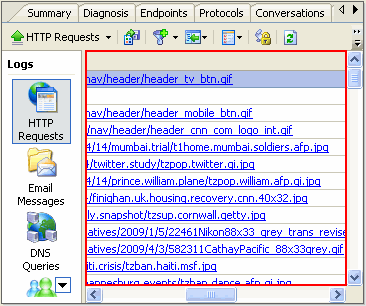
Results start showing in the Logs Tab – Http Request Option, we can see all results are in image formats. We have successfully sniffed all the images on this webpage.

How to Sniff Images Screeshot 5

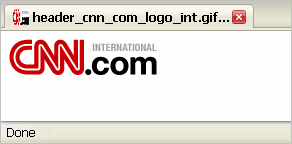
To view the image, we can click on the record, and it will be shown in a browser.

How to Sniff Images Screenshot 6


Tuesday, December 2, 2008

Network Troubleshooting Made Easy, A Colasoft Software Solution

The Challenge
As the business is becoming more and more networked, it’s always necessary for network administrators to troubleshoot network issues in shortest time possible if the network is not functioning properly. Network downtime or network malfunction may cause headaching inconvenience or even millions of business losses if not settled up in time. Without a handy tool, network troubleshooting can be time-consuming and frustrating.

Old Ways – Time-consuming and Frustrating
There are a lot of articles providing guidance on how to troubleshoot network issues in general ways. For simple networking issues, these tutorials work fine. However, for a company-level network, issues are often complicated and mixed, and these issues require deeper analysis and stronger diagnosis abilities. Obviously, old ways are no longer suitable for today’s in-time network troubleshooting demands.

Troubleshooting Network Issues in Seconds
To troubleshoot your network in time, even in seconds is now possible with Capsa’s diagnosis feature. Network issues are automatically detected and clearly identified, with possible causes and solutions provided.

Automatic Diagnosis
Based on Colasoft’s packet analysis engine, Capsa is able to automatically detect network issues in different OSI layers, such as application layer, transport layer, and network layer. All these issues are marked with different severity levels, indicating which are critical issues that need to be addressed immediately, which are just informative messages.


(Figure 1 Diagnosis Events List)

Quick Locate Suspicious Host
Once a critical network issue is detected and requires immediate handling, we can select the item from the list, then detailed information will be provided under, including source, destination, port and so on. We can easily locate the suspicious host in this field, for example, the attacking host or the host which is spamming our network. Moreover, after locating the suspicious host, we can conduct deeper analysis, such as protocol analyzing or packet decoding.


(Figure 2 Diagnosis Details)
Possible Causes & Solutions
When selecting a network issue from the list, possible causes and solutions are also provided for users to understand the issue and solve it as soon as possible.


(Figure 3 Possible Causes & Solutions)
Customizable
Depending on network sizes and network’s characteristics, we can customize the threshold that triggers one diagnosis event and the severity of the network issue.


(Figure 4 Customize Threshold)

Conclusion

It is always good to maintain the network running smoothly and properly without any problems. However, if a network issue arises, we must make sure it is quickly detected and solved before it affects the entire infrastructure and brings loss to our business. For the complexity of the network and variety of network applications, network troubleshooting is becoming more challenging and demanding. To have a powerful tool like Capsa in hand is must in everyday’s network management.

About Capsa
Capsa is packet sniffer software designed for network monitoring and troubleshooting purposes. It performs real-time packet capturing, 24/7 network monitoring, advanced protocol analyzing, in-depth packet decoding, and automatic expert diagnosing. By giving users insights into all of the network's operations, Capsa makes it easy to isolate and solve network problems, identify network bottleneck and bandwidth use, and detect network vulnerabilities, external attacks and insecure applications.

About Colasoft
Ever since 2001, Colasoft has been dedicated in providing all-in-one and easy-to-use network analysis software for customers to monitor, analyze, and troubleshoot their network. Up to now, more than 4000 customers in over 70 countries trust the flagship product – Capsa as their network monitoring and troubleshooting solution. The company also offers four free network utilities: Colasoft Packet Builder, Colasoft Packet Player, Colasoft MAC Scanner, and Colasoft Ping Tool. Learn more today at http://www.colasoft.com/


Wednesday, October 15, 2008

How to Monitor Network Traffic with Packet Sniffer

colasoft logoThere are quite a lot of software (both free and commercial) out there that perform network traffic monitoring tasks. But this article is to discuss how we can monitor network traffic with packet sniffer software. Among these packet sniffers, Colasoft Packet Sniffer is highly recommended as it is easy to use and thorough in data analysis. You can click here to download a trial version of Colasoft Packet Sniffer.

Get a Real-ime network traffic Trend Chart

If we want to get a trend chart of the network traffic, then we need to use the "Graphs" tab. "Graphs" view allows us view network statistics dynamically in different chart types, such as ling chart, bar chart, and pie chart. By selecting "Utilization" we get a real-time network traffic trend chart.

monitor network traffic with colasoft packet sniffer graph1

Learn How Much network traffic Has Been Generated by What Network Protocol


"Protocols" view will list all protocols applied in network transmission. In "Protocols" view we can monitor network traffic by each protocol. By analyzing network traffic by protocol, we can understand what applications are using the network bandwidth, for example "http" protocol stands for website browsing, "pop3" stands for email, etc.

monitor network traffic with colasoft packet sniffer graph2

Learn Which Host Has Generated or Is Generating How Much network traffic

In "Endpoints" view, we can monitor network traffic information of each node, both local and remote. In this tab we can monitor the aggregated network traffic and the real-time network traffic generated by each host (listed as IP addressess and MAC addresses). With its easy sorting feature we can easily find out which host is generating or has generated the largest network traffic.

monitor network traffic with colasoft packet sniffer graph3

Monitor network traffic Generated by Each Network Conversation

In "Conversations" tab we can monitor network traffic by each conversation and the figure out which conversation has generated the largest network traffic.

monitor network traffic with colasoft packet sniffer graph4

Inbound network traffic, Outbound network traffic, Broadcast network traffic and So on


In "Summary" we can get a quick view of the total network traffic, real-time network traffic, broadcast network traffic, multicast network traffic and so on. When we switch among the node from the explorer, corresponding network traffic information will be provided.

monitor network traffic with colasoft packet sniffer graph5

Colasoft Packet Sniffer - Capsa

Capsa is packet sniffer software designed for network monitoring and troubleshooting purpose. It performs real-time packet capturing, 24/7 network monitoring, advanced protocol analyzing, in-depth packet decoding, and automatic expert diagnosing. By giving users insights into all of the network's operations, Capsa makes it easy to isolate and solve network problems, identify network bottleneck and bandwidth use, and detect network vulnerabilities, external attacks and insecure applications.

Capsa runs under Windows 2000/XP/2003/Vista. A trial version is available at the company's web site: http://www.colasoft.com/

Monday, October 13, 2008

How to Deploy a Packet Sniffer

colasoft logoBefore we can analyze and monitor a network with a packet sniffer, we must make sure the packet sniffer is correctly deployed at the right place, so that we can capture all the traffic running in and out. The installation of a packet sniffer is easy, it is always a good idea to install a packet sniffer on a laptop, so that the laptop can be shifted around to troubleshoot different network segments. This article will discuss how to deploy a packet sniffer based on the different network device that is used.

How to Deploy a Packet Sniffer in a Switched Network

Switch is a network device working on the Data Link Layer of OSI. Switch can learn the physical addresses and save these addresses in its ARP table. When a packet is sent to switch, switch will check the packet’s destination address from its ARP table and then send the packet to the corresponding port.

Condition 1: Manageable Switch

Generally all three-layer switches and partial two-layer switches are manageable; the traffic going through other ports of the switch can be captured from the debugging port (mirror port/span port) on the core chip. To analyze the traffic going through all ports, we should deploy a packet sniffer at this debugging port (mirror port/span port). In a manageable switch network environment, we should deploy a packet sniffer like this:

packet
Condition 2: Unmanageable Switch

If our switch has no management function, we can connect a tap with the line to be monitored. Taps can be flexibly placed on any line in network. When requiring high network performance, we can add a tap to our network. In an unmanageable switch network environment, we should deploy a packet sniffer like this:


How to Deploy a Packet Sniffer in a Hubbed Network

A hubbed network is also known as shared network which is connected with a hub. In a hubbed environment, packet sniffer can be installed on any host in LAN. The entire network data transmitted through the Hub will be captured, including the communication between any two hosts in LAN, because when a packet arrives at one port, it is copied to the other ports so that all segments of the LAN can see all packets. In a hubbed network, we should deploy a packet sniffer as shown below:

packet sniffer deployment1
Colasoft Capsa is an easy-to-use packet sniffer for network monitoring and troubleshooting. It performs real-time packet capturing, 24/7 network monitoring, advanced protocol analyzing, in-depth packet decoding, and automatic expert diagnosing. By giving you insights into all of your network's operations, Capsa makes it easy to isolate and solve network problems, identify network bottleneck and bandwidth use, and detect network vulnerabilities.
 
Free counter and web stats